Let me be straight with you before we get into anything.
When most people hear the words “artificial intelligence,” one of two things happens. Either they picture a robot from a Hollywood sci-fi movie, or they immediately feel like the topic is way too technical for them and they check out. And honestly, I understand both reactions. The way this subject gets talked about in the media — all hype, all fear, all complicated buzzwords — it does not exactly make regular people feel invited into the conversation.
But here is what I want you to understand before anything else: AI is not some distant future thing you can afford to ignore. It already lives inside your smartphone, your search engine, your bank account, your doctor’s office, and the social media feed you scroll through every night. You are already using it every single day. The only question is whether you understand what it is actually doing or not.
This article is for the person who wants a clear picture of AI in 2026. Not the version that sounds like a press release from a tech company. Not the version that sounds like a science fiction disaster movie either. Just a genuinely honest, easy to follow guide about what AI is, where it is right now, and what it means for your real everyday life.
So let us get into it properly.
What Artificial Intelligence Actually Is
At its core, artificial intelligence is just a machine doing something that would normally require human intelligence to do.
Reading a sentence and understanding its meaning. Recognizing someone’s face in a photo. Deciding the fastest route to take in traffic. Translating spoken Hindi into written English in real time. Looking at an X-ray and identifying a tumor. Answering a question about history without anyone typing in a pre-written response.
All of these things used to require a human brain. Now a machine can do them too. That is AI at its most basic definition.
What makes modern AI different from older computer programs is that older programs followed explicit instructions. You told the computer exactly what to do in every situation, and it did exactly that. AI is different because instead of following a fixed script, it learns from data. You show it millions of examples, it finds patterns in those examples, and it starts making decisions on its own based on what it has learned.
Think of it like teaching a child. You do not explain the rules of grammar to a child word by word before they speak. You just talk to them constantly, they observe patterns, and eventually they start speaking on their own. Modern AI learns in a similar way. Feed it enough examples of something and it starts to understand it, and then it starts to get quite good at it.
That is the foundation everything else is built on.
The Year That Changed Everything
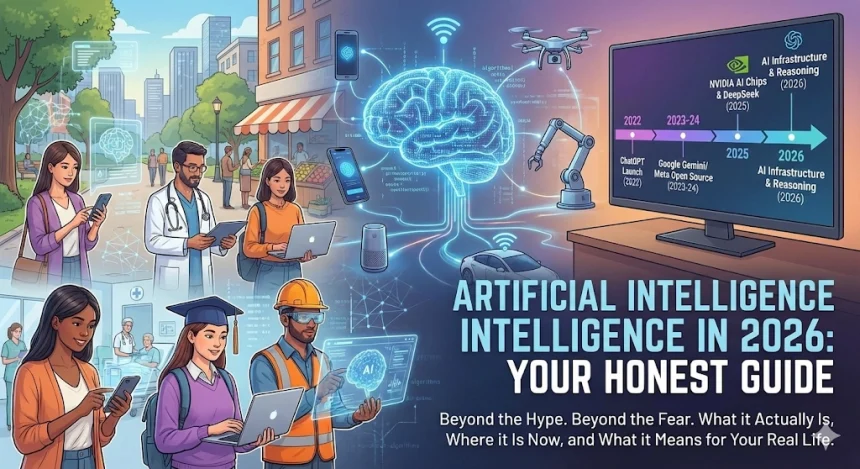
If you want to pinpoint when AI stopped being a lab experiment and became something every person on earth was suddenly talking about, it was November 2022. That was when ChatGPT launched to the public.
Within five days it had a million users. Within two months it had a hundred million. No technology in history had ever reached that many people that fast. And the reason was simple: for the first time, regular people with no technical background could sit down, type a question in plain English, and get a clear intelligent answer back. The barrier between humans and AI had essentially disappeared.
That moment set off a chain reaction that is still accelerating today in 2026. Every major technology company in the world started pouring money into AI. Google launched Gemini. Meta released open source AI models. China introduced DeepSeek, which shocked the global tech industry by showing that a relatively small team with limited resources could build a model that competed with the American giants. NVIDIA became one of the most valuable companies on the planet almost overnight because every AI system in the world needed its chips to run.
Right now in early 2026, we are not in the experimental phase anymore. AI has moved past hype and into infrastructure. It is being woven into the systems that run hospitals, governments, schools, banks, and businesses. Whether you think that is exciting or terrifying probably depends on who you are and what you do for a living.
What AI Can Do Right Now in 2026
This section is important because the capabilities of AI systems in 2026 are genuinely different from what they were even a year ago.
Understanding and Generating Language
The most visible thing AI does right now is understand and generate text. You can have a full conversation with an AI, ask it to explain a complex topic, ask it to write an email, help you debug code, summarize a 200 page document, or translate between dozens of languages with near perfect accuracy. Modern models like GPT-4, Google Gemini, and Claude can handle all of this in seconds.
What is remarkable is not just that they can do these things. It is how well they can do them. A recent study compared the creative output of AI systems against 100,000 humans and found that generative AI now outperforms the average person on certain creativity tests. That is not a headline about a future possibility. That was published in January 2026.
Seeing and Understanding Images and Video
AI can look at a photograph and tell you what is in it, who is in it, what the mood of the scene is, and what might be happening just outside the frame. It can watch a video and summarize what happened in it. It can analyze a medical scan and flag potential problems in seconds, often catching things that human doctors miss on first pass.
Researchers at the University of Michigan recently built an AI system that reads brain MRI scans in just seconds and accurately identifies neurological conditions while flagging which cases need urgent attention. That kind of tool in a hospital system could save lives every single day simply by being faster and more consistent than a human reader working a twelve hour shift.
Generating Creative Content
Text, images, audio, video, music, code. AI can produce all of these things now and it is getting better at all of them continuously. You can describe a scene in words and get a photorealistic image back. You can hum a melody and get a produced song. You can type a prompt and get a short film.
For creative professionals this is a complicated reality. Some of it is genuinely useful. Some of it raises serious questions about ownership, authenticity, and what it means to create something. Both of those things can be true at the same time.
Reasoning Through Complex Problems
This is the development that separates 2026 AI from earlier versions. The latest models do not just retrieve information and generate plausible text. They actually think through problems step by step. They consider multiple possible answers. They check their own reasoning. They arrive at conclusions the way a careful human would.
Google’s Gemini 3.1 Pro scored 77.1 percent on ARC-AGI-2, which is a benchmark designed to test novel problem solving on tasks the model could not have memorized. That is not pattern matching. That is genuine reasoning about new situations. It is the kind of capability that makes AI genuinely useful for science, medicine, law, and research rather than just content generation.
Where AI Is Showing Up in Real Life Right Now
Here is where this stops being abstract and starts being concrete.
Healthcare
AI is already being used to read medical scans, predict which patients are at risk of certain diseases before symptoms appear, assist in drug discovery, and personalize treatment plans. Stanford researchers built an AI that can predict future disease risk from a single night of sleep data. A generative AI system can now spot dangerous blood cells that human doctors commonly miss. Weill Cornell Medicine just launched a major initiative integrating AI into clinical care specifically to improve cancer and cardiovascular outcomes.
These are not future projects. They are running right now.
Education
AI tutors that adapt to how each individual student learns are becoming real classroom tools. Universities are building entire degree programs around artificial intelligence. The University of North Texas just launched a dedicated undergraduate AI major covering machine learning, natural language processing, and AI ethics. The question for education systems everywhere is no longer whether AI will change how people learn. It is how fast.
Shopping and Commerce
Salesforce recently projected that AI would drive 263 billion dollars in online purchases during the 2025 holiday season alone. AI personal shoppers that know your budget, your preferences, and your history are already operating inside major retail platforms. They compare products, find deals, and in some cases complete the purchase for you. What used to sound like a luxury concierge service is becoming a standard feature of online shopping.
Jobs and the Workplace
This is the topic everyone wants an honest answer about and very few people are willing to give one.
AI is already replacing some jobs. Customer service, data entry, basic writing tasks, certain kinds of coding, image editing, translation work. If your job consists mainly of doing something routine and repeatable, AI is already doing some version of it or will be soon.
But the full picture is more complicated than “AI takes all the jobs.” Every major technology shift in history created new jobs while eliminating old ones. The internet killed travel agents and video rental stores and gave us an entirely new digital economy that employed hundreds of millions of people in ways that did not exist before.
The realistic picture for AI is similar. Certain roles will shrink or disappear. New roles focused on working with AI, auditing AI systems, designing AI applications, and managing the things AI cannot handle will grow. The people who will be most valuable in the job market over the next decade are not the ones who ignore AI and hope it goes away, and they are not the ones who assume AI will do everything for them. They are the ones who understand it well enough to work alongside it strategically.
The Side of AI Nobody Likes Talking About
This article would not be honest if it only talked about the impressive stuff.
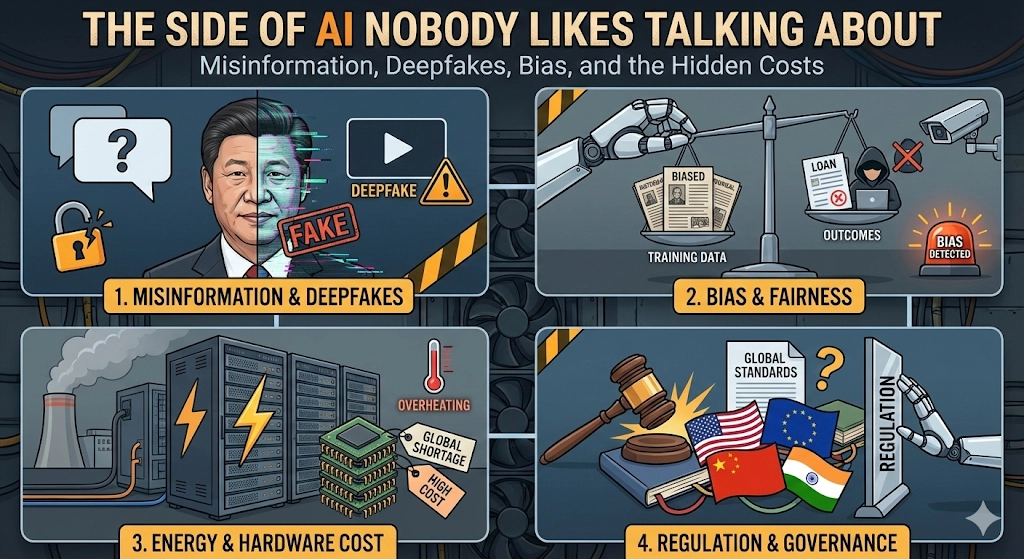
Misinformation and Deepfakes
AI can now generate realistic fake videos of real people saying things they never said. It can write convincing fake news articles. It can create fake voice recordings that sound exactly like someone you trust. In 2026, the problem of deepfakes and AI generated misinformation is one of the most serious challenges facing democracies around the world.
India recently hosted a global summit in New Delhi specifically to address international AI governance because world leaders recognized that without coordinated rules, the risks from AI in areas like election manipulation and automated warfare are genuinely serious.
Bias and Fairness
AI systems learn from human generated data. Human generated data contains human biases around race, gender, class, and countless other dimensions. If you train an AI on biased data, the AI will reproduce those biases at scale and with the added authority of being a computer system rather than a person. This has already caused real harm in hiring tools, loan application systems, and criminal justice algorithms. It is an active problem, not a solved one.
The Energy and Hardware Cost
AI is expensive. Not just in terms of money but in terms of physical resources. AI systems require enormous amounts of electricity and specialized chips to train and run. Right now the demand for AI hardware has created a global memory chip shortage, which is one of the reasons smartphone prices have risen to record highs in early 2026. The infrastructure that powers AI has very real environmental and economic costs that tend to get left out of the conversations dominated by enthusiasm.
Regulation and Governance
Who gets to decide what AI can and cannot do? Right now the honest answer is: nobody is fully in charge. The battle over regulating artificial intelligence is heading for a showdown, with the White House and individual states set to spar over who gets to govern the booming technology, while AI companies wage fierce lobbying campaigns against regulation. Meanwhile different countries are taking completely different approaches. The European Union has comprehensive AI regulation. The United States is in a messy political fight over who has jurisdiction. China is building its own AI ecosystem with its own rules. The result is a patchwork global situation with no unified standards.
What AI Cannot Do and Probably Never Will
Amid all the impressive things AI can do, it is worth being clear about what it genuinely cannot do.
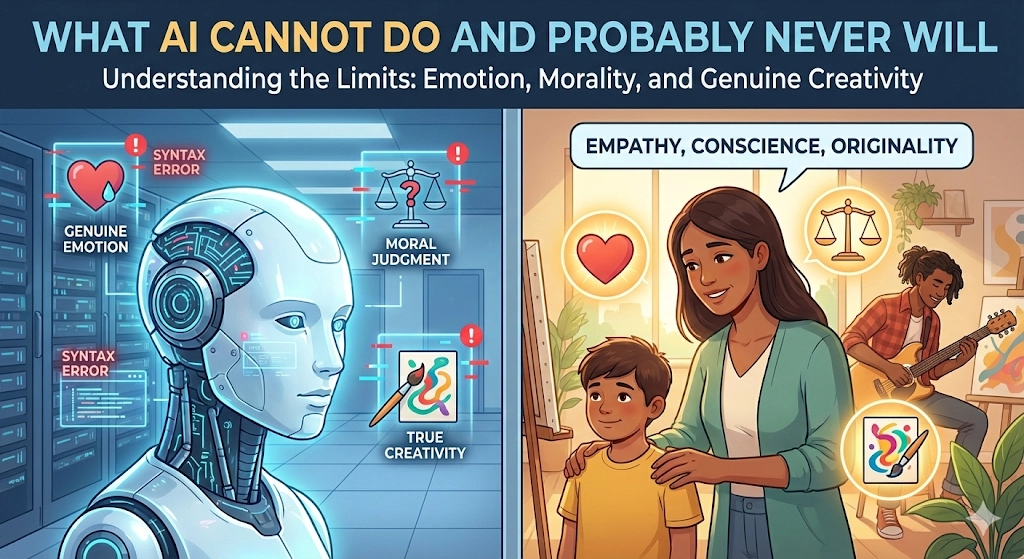
AI does not understand anything the way humans do. It processes patterns at extraordinary scale and speed. But it does not experience the world. It has no hunger, no fear, no grief, no genuine curiosity. It does not know what it feels like to be wrong about something important. It does not care about outcomes the way a person does.
AI cannot reliably exercise genuine moral judgment in novel situations. It cannot build real human relationships. It cannot be truly spontaneous in the way humans are. It cannot hold someone accountable in the way that requires actual authority and responsibility.
The version of AI most worth paying attention to is not the one that replaces human beings. It is the one that handles the repetitive, time consuming, pattern based work so that human beings can focus on the things that actually require being human.
What You Should Actually Do With All of This
If you have read this far, you probably want a practical takeaway rather than just a lot of information.
Here it is. Start using AI tools now, not later. Not because they are perfect and not because you should trust everything they produce, but because familiarity with these tools is becoming a basic professional skill the same way knowing how to use a search engine became a basic skill in the early 2000s. The people who learned search early had a real advantage. The same dynamic is playing out right now with AI.
Try ChatGPT or Google Gemini or Claude for tasks you do regularly at work or in your studies. Use it to draft something and then edit it yourself. Use it to explain a concept you find confusing. Use it to summarize a long document. Learn where it helps you and where it falls short. Build your own honest picture of what it is actually capable of rather than relying on what other people tell you it is.
The goal is not to become dependent on it. The goal is to understand it well enough to use it when it helps and to recognize when it is wrong, which it very much can be.
Where AI Is Going From Here
The trajectory of AI development in 2026 points clearly in one direction: it is going to keep getting more capable, more embedded in daily life, and more difficult to separate from the systems society depends on.
In 2026, Chinese open source models are narrowing the gap with Western frontier models faster than anyone predicted, the political fight over AI regulation is intensifying, and AI agents that can browse the web and complete tasks on your behalf are moving from experimental to mainstream. NVIDIA just unveiled its new Vera Rubin AI platform at CES 2026, the most powerful hardware the company has ever built, specifically designed to handle the next generation of AI at scale.
What that means for ordinary people is simple: the window to get familiar with AI before it becomes unavoidable is shrinking. Not because AI is a threat, but because it is quickly becoming as fundamental as the internet itself.
The people who understood the internet early did not just have a technical skill. They had a completely different lens through which to understand the world. AI is offering that same kind of lens right now, in this specific moment, to anyone willing to actually pay attention.
That is why this matters. Not because it is cool technology. But because understanding it is quickly becoming part of how you understand the world you live in.
Have questions about AI or want to go deeper on any specific topic covered here? Drop them in the comments below. I read every single one.
What is artificial intelligence in simple words?
Artificial intelligence is when a machine does something that normally requires human intelligence, like understanding language, recognizing images, making decisions, or solving complex problems. Modern AI learns from large amounts of data rather than following fixed instructions.
Is artificial intelligence dangerous?
AI has real risks including deepfakes, misinformation, job displacement, and bias in automated systems. However it also has significant benefits in medicine, education, and productivity. The key is developing proper governance and using AI responsibly rather than ignoring either the benefits or the risks.
How is AI being used in everyday life in 2026?
AI is used in smartphone assistants, search engines, social media algorithms, navigation apps, fraud detection in banking, medical diagnosis, online shopping recommendations, translation tools, and content creation. Most people use AI dozens of times per day without realizing it.
Will AI take away jobs?
AI is already replacing some repetitive and pattern based tasks. However every major technology shift in history has also created new kinds of jobs. The most realistic outcome is that AI eliminates certain roles while creating new ones focused on working with and managing AI systems. People who learn to use AI effectively will have a real advantage.
What is the difference between AI and machine learning?
Machine learning is a specific type of artificial intelligence where systems learn from data rather than being explicitly programmed. All machine learning is AI but not all AI is machine learning. Machine learning is currently the dominant approach in building modern AI systems like ChatGPT and Google Gemini.