Every successful company you admire has a carefully planned growth strategy behind it. Apple, Amazon, Zomato, CRED — inhe accidentally bada nahi mila. These companies used specific, proven growth strategies to capture their markets — and the good news is, most of these strategies you can start applying to your own business today.
In this article, we are covering exactly that — 7 real growth strategies that actually work, with real examples from companies that have already done it. No fluff. Sirf actual tactics jo results deti hain.
Let’s get into it.
What Are Growth Strategies and Why Do They Matter?
A growth strategy is a plan that a company uses to increase its market share, revenue, or user base over time. It is not just about running ads or posting on social media — it is a structured, intentional approach to scaling a business.
Jo companies bina ek clear growth strategy ke run karti hain, woh zyada tar plateau ho jaati hain after their initial traction. They get stuck. The ones that keep growing — they are almost always executing one or more of the strategies we are about to cover.
Toh seedha point pe aate hain.
What Are the 7 Growth Strategies Used by Successful Companies?
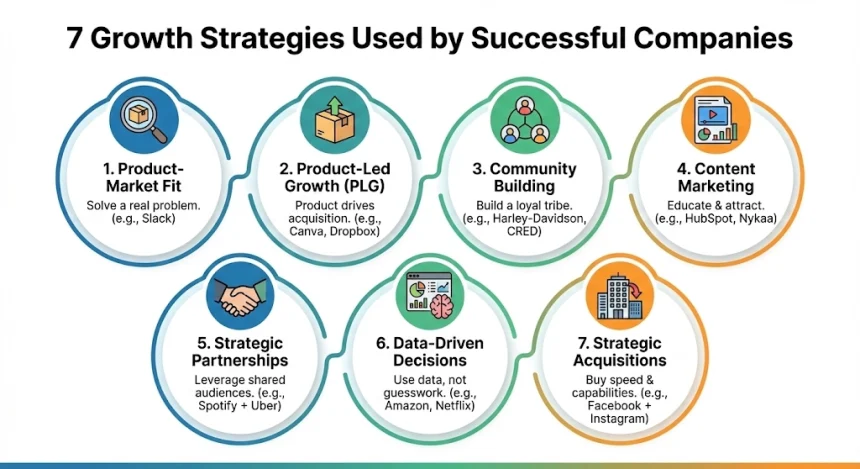
Yeh section most important hai. Let’s go strategy by strategy.
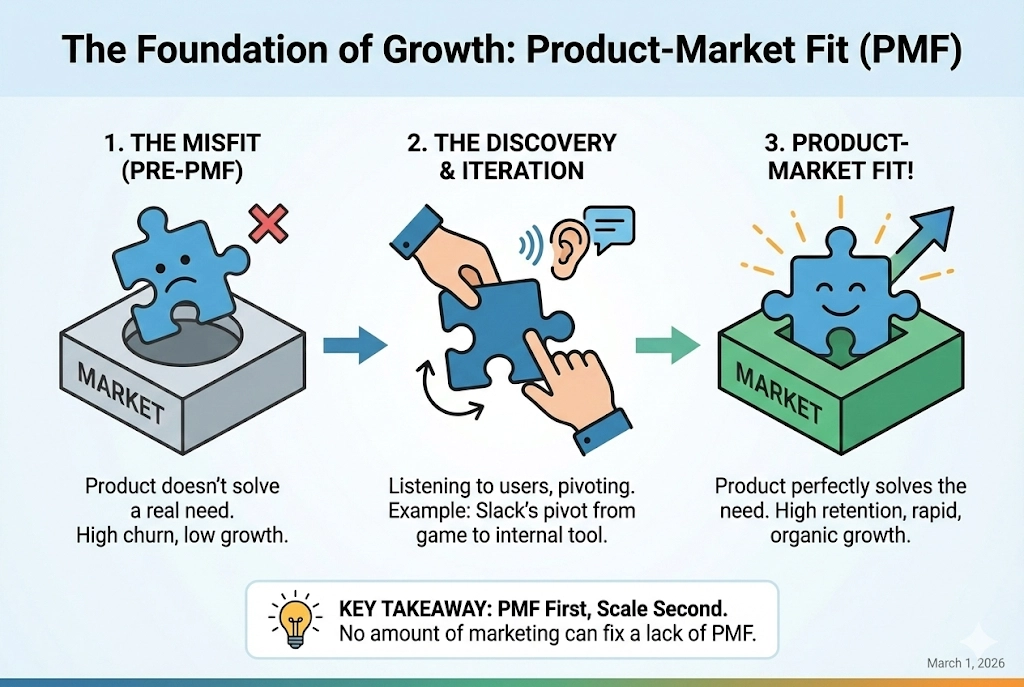
1. Start With Product-Market Fit — And Stay Obsessed With It
If there is one thing that determines whether any growth strategy will work or fail — it is product-market fit. Simple matlab: your product solves exactly the problem your target customer has, in exactly the way they want it solved.
Slack is the perfect example. When Stewart Butterfield built Slack in 2013, he originally created it as an internal tool for his own team. Phir realize hua — yeh problem sirf unki company ko nahi, the entire corporate world faces this. They pivoted, refined the product, aur sirf 24 hours mein 8,000 signups mile.
The first lesson in growth strategies is this: confirm that people actually want your product before you try to scale it. Tab scale karo.
Real tactic you can use right now: Talk personally to your 10 best customers. Ask them why they chose your product, what they love most, and what is missing. Yeh conversations will tell you exactly which growth strategy will actually work for you.
2. Product Led Growth — The Growth Strategy That Scaled the Fastest
Product-led growth (PLG) is a strategy where the product itself becomes the primary driver of user acquisition and retention. No heavy sales team needed. No expensive ad campaigns. Product khud hi convert aur retain karta hai.
Canva did exactly this. Start for free, make a design, share it with someone — aur tab woh person bhi Canva sign up karta hai. Every share was a free acquisition. Today Canva’s valuation is above $26 billion, and among all growth strategies, PLG has been one of their most cost-effective.
Dropbox used the same approach. Share a file, the person receiving it downloads Dropbox. Viral loop automatically ban gaya. The company went from 1 million to 100 million registered users in just 15 months.
Real tactic you can use right now: Identify one shareable moment inside your product. What is the action where a user would naturally invite someone else or share something? Usi moment ko optimize karo first — baaki sab baad mein.
3. Community Building — The Most Underrated Growth Strategy
Among all the growth strategies out there, community building is probably the most underrated. Jab tumhare customers sirf customers nahi rehte — balki ek community ka hissa ban jaate hain — retention and word-of-mouth both improve automatically.
Harley-Davidson — think about this for a second. This is not just a motorcycle company. It is a lifestyle and an identity. The Harley Owners Group (HOG) has over 1 million active members. People buy Harley because they want to be part of the community — product isliye kharid rahe hain kyunki unka self-image ussi mein fit hota hai.
In India, CRED is an excellent case study. CRED built an exclusive community for high-credit-score individuals. Exclusivity ne aspirational value create ki. People used CRED because it felt like a status symbol. As a growth strategy, this worked exactly because it made users feel special.
Real tactic you can use right now: Build a private group for your customers — WhatsApp, Telegram, ya Discord pe. Offer exclusive content, early access, or direct founder access. Community feel create karo. Sirf customer list mat banao.
4. Content Marketing — The Long Game Growth Strategy That Always Pays Off
Content marketing is a growth strategy that feels expensive upfront — time aur effort dono ke maamle mein — but long-term mein ek compounding asset ban jaati hai.
HubSpot built its entire business on content. In 2006, they popularized the concept of inbound marketing. They gave away free blogs, guides, and tools — consistently, for years. Today HubSpot’s organic traffic is above 8 million visits per month, aur yeh sab bina paid ads ke. Their core growth strategy was simple: be the most helpful resource in your space.
Nykaa did the same in India’s beauty space. YouTube tutorials, skincare guides, ingredient breakdowns — Nykaa first educated women about beauty, aur tab woh naturally Nykaa se hi buy karti thin. Content pehle, conversion baad mein.
Real tactic you can use right now: Identify the top 10 questions your potential customers are Googling in your industry. Create the best possible content for those 10 questions. Not just blog posts — videos, infographics, comparison guides — jo bhi format tumhare audience ke liye best kaam kare.
5. Strategic Partnerships — Growth Strategies Where 1+1 Equals 10
Strategic partnerships work when two companies have overlapping audiences but are not direct competitors. Yeh growth strategy fast market expansion ke liye perfect hai — without burning through your budget.
Spotify and Uber’s partnership demonstrates this concept perfectly. You get into an Uber, you can play your Spotify — a simple integration that created value for both brands. Uber rides felt better, Spotify usage increased. Kisi ne kuch extra spend nahi kiya — they just shared their existing audiences with each other.
In India, look at Jio’s model with content partners. Jio onboarded Netflix, Amazon Prime, and Disney+ early on. For users it was an irresistible bundle. Jio scaled fast, aur content partners ko ek massive new distribution channel mila overnight.
Real tactic you can use right now: List 5 brands that your customers also use but that are not your competitors. Reach out for a simple cross-promotion or bundled offer. Email swap, social collaboration, ya joint webinar — kuch bhi jo dono audiences ko value de.
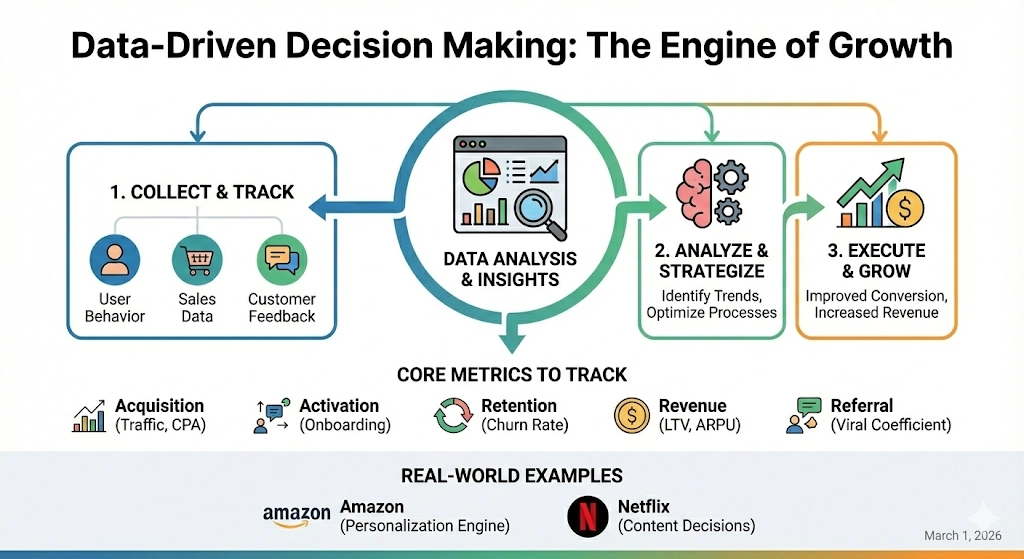
6. Data-Driven Decision Making — The Growth Strategy That Never Lies
Companies that grow consistently have one thing in common — woh data ko seriously lete hain. Every growth decision has numbers behind it, not guesswork.
Amazon’s entire business model is built on data. Recommendation engine, dynamic pricing, inventory decisions — yeh sab real-time data se driven hain. One famous example: Amazon discovered that every 100ms improvement in page speed increased their revenue by 1%. Ek company ne yeh 2006 mein discover kiya tha — and it still drives how they build products today.
Netflix is another example. They do not decide which show to make based on gut feeling — they decide based on data. Viewing patterns, pause points, rewatch rates — sab analyze hota hai. House of Cards was made specifically because data showed their users loved political dramas and David Fincher both. It was a calculated bet, not a blind one.
Here are the core metrics successful companies track as part of their growth strategies:
| Metric Type | What to Track |
|---|---|
| Acquisition | Traffic sources, Cost Per Acquisition, conversion rates |
| Activation | Onboarding completion, first key action taken |
| Retention | 30 / 60 / 90 day retention rates, churn rate |
| Revenue | ARPU, Lifetime Value, revenue per channel |
| Referral | Referral rate, viral coefficient |
Real tactic you can use right now: Identify one single North Star Metric for your business — the one number that best represents whether your customers are getting real value. Track it every week. Har decision uski improvement ke liye lo.
7. Strategic Acquisitions — Buy What You Cannot Build Fast Enough
Yeh growth strategy typically larger companies ke liye hoti hai — but the concept applies to startups too, in the form of talent acquisition, tool acquisitions, or strategic hirings.
Facebook bought Instagram for just $1 billion in 2012 — when Instagram had only 13 employees and zero revenue. Zuckerberg saw that Instagram was defining the future of mobile photography, aur Facebook ka mobile product weak tha. It was both a defensive acquisition and an offensive growth play. Today Instagram alone is estimated to be worth over $100 billion.
Google’s acquisition strategy is legendary. YouTube, Android, DeepMind, Waze — Google bought all of these when they were still early. Yeh sab independent growth engines ban gaye jo Google ke overall ecosystem ko continuously strengthen karte hain.
Real tactic you can use right now: Acquisition does not have to mean buying companies. Identify the specific skills in your team that are blocking your growth right now. Hire aggressively for those skills. Yeh bhi ek form of strategic acquisition hai — aur often the most impactful one for early-stage businesses.
Growth Strategies Comparison — Which One Is Right for You?
| Stage | Best Growth Strategies to Focus On |
|---|---|
| Early Stage (0–100 customers) | Product-market fit, Community building |
| Growth Stage (100–10,000 customers) | Product-led growth, Content marketing, Data |
| Scale Stage (10,000+ customers) | Strategic partnerships, Acquisitions, Community |
Pick one or two strategies for your current stage and go deep on them. Sab ek saath try karna — yeh sabse common mistake hai growing companies ki, and it leads to executing everything poorly instead of one thing really well.
What Makes These Growth Strategies Actually Work?
Yeh ek important point hai jo most articles miss karte hain.
Every strategy on this list has worked for multiple companies across different industries. But the ones that failed — they were not bad strategies. The execution was inconsistent.
Growth strategies ke baare mein ek common myth yeh hai ki you need the perfect strategy. You do not. Slack did not invent PLG. HubSpot did not invent content marketing. What they did was execute their chosen strategy better and longer than anyone else in their space.
That is the real differentiator.
Final Verdict — Growth Strategies Work, But Consistency Wins
One thing is clear from all of these examples: no growth strategy delivers overnight results. Slack’s PLG loop built slowly. HubSpot’s content marketing compounded — it took years to see real results. Harley’s community was cultivated over decades.
Companies that consistently grow do not just choose smart strategies — woh unhe long enough pursue karti hain ki results actually aayein.
So pick the growth strategy most relevant to your current stage and resources. Then execute it seriously for at least 6 months before switching or pivoting.
Consistency, patience, and data — yeh teeno cheezein growth strategies ko actually work karate hain.
Apne business ke liye kaunsi growth strategy most relevant lagti hai? Neeche comment mein batao — I personally read every one.
What are growth strategies in business?
Growth strategies are structured plans that businesses use to increase their revenue, user base, or market share over time. The most effective growth strategies include product-led growth, content marketing, community building, strategic partnerships, and data-driven scaling. Companies like Amazon, Canva, and HubSpot each used specific growth strategies to achieve their scale.
Which growth strategy is best for startups?
For early stage startups, product-market fit validation and community building are the most effective growth strategies to begin with. Once you have a stable user base, product-led growth and content marketing become the most cost-efficient ways to scale. Paid growth strategies work best only after organic growth has been established first.
How do successful companies use content marketing as a growth strategy?
Successful companies like HubSpot and Nykaa used content marketing by consistently creating helpful, educational content for their target audience before asking for any purchase. This built trust, drove organic traffic, and made them the go-to resource in their space. Over time, this became a compounding asset that generated leads at near-zero cost.
What is product led growth and why is it a powerful growth strategy?
Product led growth (PLG) is a growth strategy where the product itself drives user acquisition and retention — instead of relying on a sales team or advertising. Canva and Dropbox are the most cited examples. Users share the product naturally, which brings in new users for free. It is one of the fastest and most capital-efficient growth strategies available to modern companies.
How long does it take for growth strategies to show results?
Most growth strategies show early patterns within 3 to 6 months, but real compounding effects typically appear after 12 to 18 months of consistent execution. Content marketing takes the longest but delivers the most sustainable long-term results. The biggest mistake companies make is switching strategies too early before giving them enough time to work.