The papers are done. The answer sheets are gone. And now begins the part that nobody tells you is actually harder than the exams themselves.
The waiting.
If you appeared for the CBSE Class 10 board exams this year, you already know the papers ran from February 17 to March 11, 2026. Mathematics, Science, Social Science, English, Hindi and everything else in between. Some papers felt okay. Some probably did not. And right now you are doing exactly what 43 lakh other students across the country are doing — checking news sites, asking friends in WhatsApp groups, and wondering when the CBSE board result 2026 class 10 is actually going to be out.
This article answers all of that properly.
अगर आप छात्र हैं और सरकारी योजनाओं के बारे में जानना चाहते हैं, तो यह जानकारी आपके लिए उपयोगी हो सकती है।
Not vague. Not just a list of websites you already know about. The complete honest picture of when the result is expected, exactly how to check it step by step, what your marksheet will contain, what happens if things do not go the way you hoped, and what your smartest moves are once the result is in your hands.
Let us get into it.
CBSE Board Result 2026 Class 10 Expected Date — What the Data Actually Says
The official date has not been announced. It never is until 24 to 48 hours before. CBSE has been doing this for years and 2026 is no different. Anyone telling you with full certainty that the result is dropping on a specific date is guessing, not reporting.
But patterns built over years are worth something. Here is what the actual data shows.
In 2025, Class 10 exams ended on March 18 and the result came on May 13. That was 56 days after the final exam. In 2024, exams ended on March 13 and the result came on May 13 as well, exactly 60 days later. In 2023, results came on May 12. Go back further and the trend holds: normal years land in the first two weeks of May, consistently.
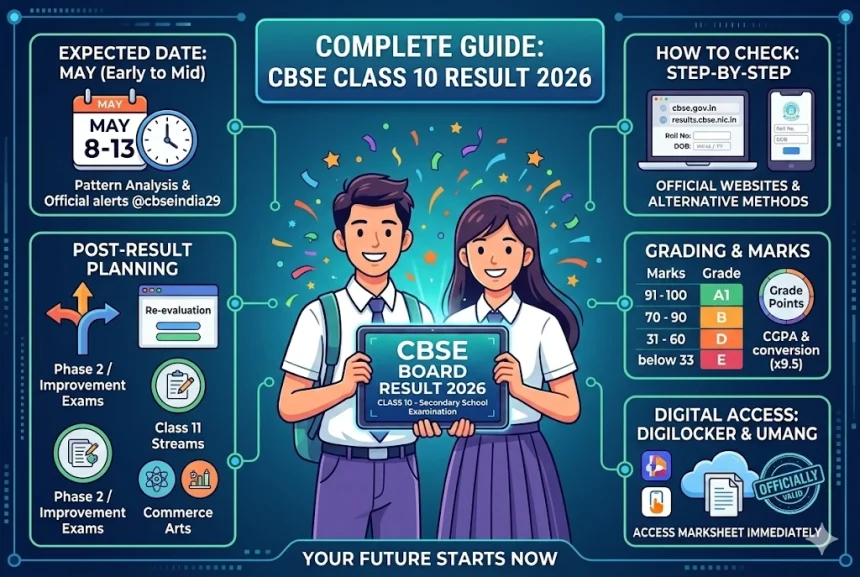
This year the Class 10 Phase 1 exams concluded on March 11, 2026. Following the 60 day pattern, the CBSE board result 2026 class 10 is expected around May 9 to May 13, 2026.
Mark that window. Start checking from May 8 onwards. Do not panic if nothing comes on the first day you check. The board works on its own timeline and it has been reliable in recent years.
One thing worth knowing right now: CBSE announces the result date on its official social media and website just a day or two before. Follow @cbseindia29 on X formerly known as Twitter for the fastest alert.

The Big Change This Year — Two Exam System for Class 10
This is something every student who appeared for CBSE Class 10 in 2026 needs to understand clearly because it directly affects how results work this year.
CBSE has introduced a two-phase board exam system for Class 10 starting 2026. The main Phase 1 exams ran from February 17 to March 11. Phase 2 exams are scheduled from May 15 to June 1, 2026. Phase 1 results are expected around early to mid-May. Phase 2 results will follow by end of June 2026.
If you pass Phase 1 and want to improve your marks in up to three subjects, you can appear for those subjects in Phase 2. The better of the two scores in each subject counts as your final result. Students who fail in three or more subjects in Phase 1 will be categorized as Essential Repeat and must reappear the following year.
For students who fail one or two subjects in Phase 1, the Phase 2 exam functions as a compartment opportunity within the same academic year itself. That is genuinely useful because it removes the older situation where failing a subject meant waiting an entire year.
Schools accept the Phase 1 provisional marksheet for Class 11 admission. So even if you are waiting for your Phase 2 result, you can start the Class 11 process using the Phase 1 document.
How Many Students Are Appearing This Year
Understanding the scale of CBSE 2026 boards gives you context for why the result takes the time it does and why the websites crash on result day.
More than 43 lakh students are appearing for CBSE board exams this year across India. Class 10 Phase 1 saw around 25 lakh students. Examinations were conducted at over 8,000 centres across India and abroad.
अगर आप पढ़ाई के लिए नए टेक्नोलॉजी टूल्स और गैजेट्स के बारे में जानना चाहते हैं, तो यह लेख भी आपके लिए उपयोगी हो सकता है।
Twenty five lakh answer sheets. Each one manually evaluated by trained examiners following a specific marking scheme. CBSE is using On-Screen Marking this year, which means scanned copies of answer sheets are evaluated digitally rather than physically, making the process faster and reducing errors. But even with OSM, the volume is enormous.
When you understand that scale, the 55 to 60 day result timeline makes complete sense rather than feeling like unnecessary delay.
What Are the Passing Marks for CBSE Class 10 in 2026
This is the second most searched question right now after the result date and it deserves a direct clear answer.
Students must score at least 33 percent marks in each subject to pass CBSE Class 10. In subjects that include practical exams, students need to pass both the theory and the practical components separately.
This is the part that catches people off guard. Passing is not about your total aggregate. If you scored 80 percent overall but got 30 percent in Science theory, you would be placed in compartment for Science regardless of your overall performance.
The 33 percent rule applies to each subject individually and to theory and practical separately within subjects that have both components.
In terms of historical context, CBSE Class 10 recorded a 93.60 percent pass rate in 2024. The vast majority of students who appear do clear the exams. The compartment numbers are relatively small.
Understanding the Grading System on Your Marksheet
CBSE does not give you only a percentage on your marksheet. You will see grades and grade points alongside your actual marks. Understanding this before the result drops helps you read it correctly on result day instead of being confused by numbers and letters you did not expect.
If you score between 91 and 100 marks in a subject, you get A1 grade with grade point 10. Marks between 81 and 90 give you A2 with grade point 9. The 71 to 80 range is B1 with grade point 8. Between 61 and 70 is B2 with grade point 7. Marks from 51 to 60 give C1 with grade point 6. Between 41 and 50 is C2 with grade point 5. And 33 to 40 is D grade with grade point 4. Below 33 in any subject is E grade, which means fail.
Your CGPA on the marksheet is the average of grade points from your five main subjects. To convert CGPA to an approximate percentage, multiply it by 9.5. A CGPA of 9.2 translates to roughly 87.4 percent.
What Your CBSE Class 10 Marksheet Will Contain
When the result is out and you open your scorecard, here is exactly what will be on it. Check every single one of these carefully on result day.
The marksheet will show your full name, father’s name, mother’s name, roll number, school name, examination centre name, names of all exam subjects, subject-wise score of both theory and practical exams, total marks scored, grade point based on total marks, and pass or fail remark both subject-wise and overall.
The moment you open the result, verify your name spelling, your parents’ name spellings, your roll number, and your subject-wise marks. Any discrepancy needs to be flagged to your school immediately. Getting corrections done after the window closes is a painful and time consuming process.
Step by Step Guide to Check CBSE Board Result 2026 Class 10
This is the section most people came here for. Here is the complete process, explained properly, not just thrown into a quick list.
Before the result is declared, gather these things and keep them ready. Your roll number printed on your admit card. Your school number also on the admit card. Your admit card ID. Your date of birth. Without all of these, the official portal will not display your result.
Step one is to open the official CBSE result website. The two main official addresses are cbse.gov.in and results.cbse.nic.in. Both are official and both carry the result. A third website cbseresults.nic.in has also been used in past years. Bookmark all three right now before result day so you are not searching for links in a panic when the result drops.
Step two is to find the Class 10 result link on the homepage. On result day CBSE puts a prominent banner link on the homepage of both websites. It will say something like CBSE Class 10 Result 2026 or Secondary School Examination Result 2026. Click that link.
Step three is entering your details. A form will appear asking for your roll number, school number, admit card ID, and date of birth. Enter every digit carefully. One wrong number means the system will show no result found.
Step four is clicking submit and waiting. This is the step that frustrates most students on result day. When Class 10 results are declared, 25 lakh students and their families all try to access the websites at the same time. The servers slow down significantly and sometimes crash for short periods. If the page does not load, do not keep refreshing aggressively every two seconds. Wait three to five minutes and try again calmly. The result is not going anywhere.
Step five is saving your result the moment it loads. Take a screenshot immediately before doing anything else. Then use the print or download option to save a PDF copy of your scorecard. Email that PDF to yourself and to a parent so you have multiple backups.
Step six is checking every detail on the marksheet as described in the previous section before you share or celebrate.
What to Do When the Official Website is Down — Alternative Ways to Check
The official websites going slow or temporarily down on result day is almost guaranteed. Here is how to access your result without depending on them alone.
DigiLocker is the most reliable alternative and it is where CBSE actually pushes the official digital marksheet. This is not a third party service. It is a government of India platform. Create your DigiLocker account before results are announced by going to digilocker.gov.in or downloading the DigiLocker app. Use your Aadhaar card to set it up. Once results are declared, your official CBSE marksheet will appear automatically in your documents section. You do not need to search or enter anything on result day. It just appears.
The UMANG app is another government platform where CBSE results are accessible. Download the app from the Play Store or App Store, search for CBSE in the services section, and enter your credentials when the result goes live.
The SMS facility is available for students without stable internet. CBSE announces a specific number and format for SMS on result day. The typical format is your roll number sent to an announced number. Check cbse.gov.in on result day for the exact SMS details.
Third party education portals like examresults.net and indiaresults.com also mirror CBSE results and tend to handle the traffic slightly better than the official sites. These are safe to use for checking your marks but always verify the numbers on the official site before using them for anything important.
What Happens If You Fail One or Two Subjects
This section is important and most articles skip it or put it at the end where nobody reads it. So it goes here.
If you fail in one or two subjects in Phase 1, you will be placed in the compartment category for those subjects. In 2026, with the new two-phase system, compartment students can appear for those subjects in Phase 2 itself, which runs from May 15 to June 1. The Phase 2 result comes by end of June.
If you clear the subject in Phase 2, you pass for the academic year and can move to Class 11. Schools accept the provisional Phase 1 marksheet during this waiting period so admission processes do not stall.
For students who fail three or more subjects in Phase 1, the category is Essential Repeat. These students will need to reappear the following year. This category also existed in previous years but the two-phase system now gives a clearer distinction between one-or-two-subject failures and more widespread failure.
A compartment result is not the end of anything. Thousands of students clear compartment every year and go on to do very well in Class 11 and beyond. One subject in one exam does not define what happens next.
What to Do After the Result is Declared — Practical Next Steps
A lot of articles stop at how to check and leave students without any guidance on what actually needs to happen in the days after. Here is what matters.
Within the first day, download and save multiple copies of your digital marksheet from DigiLocker. Email it to yourself. Share with a parent. The printed version from school comes later but the digital copy is official and immediately usable.
If you want to challenge your marks, act quickly. CBSE opens the window for verification of marks, photocopy of answer sheets, and re-evaluation within a week of result declaration. Missing this window means you cannot apply. Check cbse.gov.in for exact dates and fees as soon as results are out.
Verification checks whether all your answers were evaluated. Photocopy lets you see your actual marked answer sheet. Re-evaluation gets your paper marked by a different examiner. These are different processes with different fees and different timelines. Read the official notice carefully before applying.
If you are in compartment for one or two subjects, register for Phase 2 exams as soon as the registration window opens. Do not delay. Use the time between Phase 1 result and Phase 2 exams to specifically work on those subjects.
Start thinking about Class 11 stream choice before result day. If you are scoring around 80 percent or above, Science with Mathematics is usually available. Below that, all three streams are open depending on the school and your interest. The stream you choose shapes your board exams in Class 11 and 12, your competitive exam eligibility, and your undergraduate options. This decision deserves thought and honest conversation with your family rather than a rushed call on result day.
Is the DigiLocker Marksheet Officially Valid?
Yes. Completely.
A lot of students and parents are unsure whether the DigiLocker document is somehow less official than the printed marksheet that comes from school later. It is not. The DigiLocker document is issued directly by CBSE and carries the same legal standing as a printed marksheet. It is accepted by universities, colleges, passport offices, Aadhaar centers, and government departments for all official purposes.
You do not need to wait for the printed version to start any admission process. The digital marksheet from DigiLocker is sufficient from the moment it appears in your account.
CBSE Result History — A Quick Look at the Pattern
Knowing where results have come in previous years helps you understand the timeline clearly.
In 2025 the result came on May 13. In 2024 it came on May 13. In 2023 it came on May 12. In 2022 results came on July 22 due to pandemic disruptions. In 2021 they came on August 3 for the same reason. In 2019 results came on May 6. And going further back, 2018 was May 29, 2017 was June 3, 2016 was May 28.
Under normal academic years without any external disruptions, the May window is consistent and reliable. The 2026 result is tracking exactly on that pattern based on when the exams ended.
A Note for Every Student Reading This Right Now
This is not keyword content. This is just something worth saying honestly.
The weeks between finishing boards and getting results are genuinely strange. You cannot go back and change anything about how the papers went. The waiting feels useless. Social media does not help because there is always someone claiming their exam was easy and someone else predicting result dates with a confidence that is entirely made up.
Here is what is actually true. You did what you could with the preparation and time you had. The result will be whatever it is. And whatever it is, it is one data point in a long story that is still being written.
If it goes well, celebrate it genuinely. Then make a good decision about Class 11 and move forward with a real plan.
If it does not go the way you hoped, remember that CBSE Class 10 marks matter less at age 25 than they feel like they do at age 15. People have built extraordinary lives after struggling in board exams. The difference is not who scored highest. It is who figured out what they wanted and worked toward it with some consistency.
Keep checking from May 8 onwards. Have your roll number ready. And until then, try to spend time doing things that are not about waiting for a result you cannot change.
Have specific questions about the CBSE Class 10 result process, re-evaluation, or what to do after results? Drop them in the comments below. Every comment gets read and answered.
When will CBSE Class 10 result 2026 be declared?
CBSE Class 10 result 2026 is expected around May 9 to May 13, 2026, based on the consistent 60 day pattern from previous years. The Class 10 Phase 1 exams ended on March 11, 2026. CBSE does not announce the exact result date until 24 to 48 hours before declaration. Check cbse.gov.in regularly from May 8 onwards.
How to check CBSE Class 10 result 2026 step by step?
Visit cbse.gov.in or results.cbse.nic.in on result day. Click the Class 10 result 2026 link on the homepage. Enter your roll number, school number, admit card ID and date of birth. Click submit to view your scorecard. Download or screenshot the result immediately. Also check DigiLocker at digilocker.gov.in for your official digital marksheet.
What are the passing marks for CBSE Class 10 in 2026?
Students need at least 33 percent marks in each subject individually to pass CBSE Class 10 in 2026. For subjects with practicals, both theory and practical must be passed separately. Failing in one or two subjects places a student in the Compartment category with a chance to clear in Phase 2 exams in June 2026.
What is DigiLocker and is the CBSE marksheet on it valid?
DigiLocker is an official government of India platform at digilocker.gov.in where CBSE pushes your digital marksheet directly when results are declared. The document is fully legally valid and is accepted by colleges, universities, and government offices. Create your DigiLocker account using Aadhaar before result day to access your marksheet instantly.
What is the Phase 2 exam in CBSE Class 10 2026?
In 2026 CBSE introduced a two-phase system for Class 10. Phase 2 exams run from May 15 to June 1, 2026. Students who passed Phase 1 can appear in Phase 2 to improve marks in up to three subjects, with the better score counting as the final result. Students who failed one or two subjects can use Phase 2 as a compartment opportunity within the same academic year.
https://cbse.gov.in (Official CBSE Website)
https://results.cbse.nic.in (Official CBSE Results Portal)
https://digilocker.gov.in (DigiLocker for Official Digital Marksheet)