Let me be upfront about something before we get into any of this.
Most new gadgets are not worth buying. The majority of what gets announced at tech shows every year is either vaporware that never ships on time, an incremental update dressed up as a revolution, or a genuinely clever idea that is simply not ready for everyday real life yet. The cycle repeats itself every January at CES, every spring at MWC in Barcelona, every September at Apple events, and any other time a brand wants a news cycle.
But then there are the other ones.
The gadgets that actually change how you do something daily. The ones you end up recommending to everyone you know not because they look impressive on a desk but because they solved a real problem. The ones where you use them once and wonder how you lived without them.
That second category is exactly what this article is about.
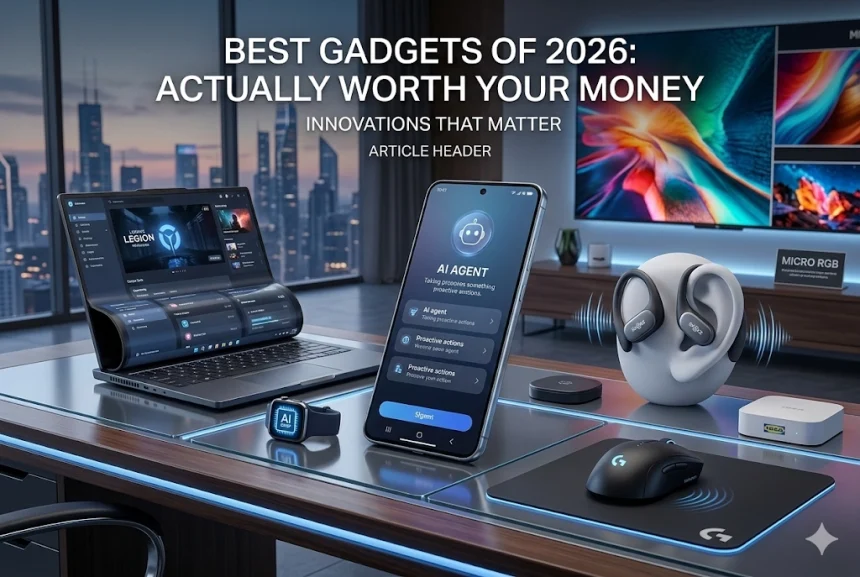
We just came through CES 2026 in Las Vegas and MWC 2026 in Barcelona, the two biggest technology shows on the planet, where every major company puts its best foot forward for the year ahead. After sorting through all of it, here are the gadgets that genuinely stood out in 2026 and why each one actually matters.
Why Best Gadgets 2026 Feel Different From Every Year Before
Before we talk about individual products, there is a shift happening in consumer technology right now that is worth understanding. It changes how you should think about every gadget on this list.
For years, gadgets were sold on specs. More megapixels. Faster processor. Bigger battery. Higher resolution screen. Manufacturers competed on numbers and marketing teams sold you those numbers. And for a while that actually translated into meaningfully better everyday experiences.
That era is basically over now.
The specs race has hit a wall because phones and laptops and TVs are already genuinely very good. The average smartphone from two or three years ago can do almost everything a current model can do. So the industry pivoted. Instead of raw specs, the big push in 2026 is toward two things: artificial intelligence that lives directly on your device rather than in a cloud somewhere, and form factors that do things nobody has seen before.
The result is that 2026 gadgets are arguably the most interesting they have been in years. Not because everything is dramatically faster or sharper, but because some of them actually work differently. And working differently is what makes a gadget worth your time.
Samsung Galaxy S26 Series — More AI, Higher Price
Let us start with the most searched gadget of early 2026.
Samsung Galaxy Unpacked in February gave us the S26 lineup and the reaction was split right down the middle. The S26 and S26 Plus both came in at 100 dollars more than the same models in the S25 lineup. A price increase without any major hardware upgrades to justify it on paper.
So what did Samsung give you for the extra money? Agentic AI features. The kind of AI that does not just answer questions but actually takes actions on your behalf. It can browse, book, message, and manage tasks proactively. Samsung is betting that AI functionality is worth paying more for even when the physical hardware underneath stays largely the same.
Whether that trade is worth it depends entirely on how much you actually use AI features day to day. If you are someone who already uses your phone heavily for productivity and wants a device that increasingly manages things for you, the S26 Ultra makes a compelling case. If you mostly use your phone for social media, photos, and calls, the S26 lineup does not give you a compelling reason to upgrade from an S24 or S25.
The camera improvements on the Ultra are genuinely good though. Low light performance is better than any previous Samsung and zoom consistency has improved significantly. For photography enthusiasts, that alone might tip the decision.
Lenovo Legion Pro Rollable — A Laptop Screen That Expands Like a Scroll
This is the gadget from CES 2026 that had everyone stopping and staring. Not because it is available to buy right now but because it shows where things are going in a way that feels genuinely exciting.
The Lenovo Legion Pro Rollable is a gaming laptop with a 16 inch screen that can physically roll out to become a 24 inch ultrawide display in what Lenovo calls Arena Mode. The screen extends from the body of the laptop like a scroll. You use it as a normal portable laptop when you are moving. You expand it to a massive canvas when you sit down to game or work seriously.
Lenovo’s previous rollable experiments were concept products that never made it to retail. But the Legion Pro Rollable is being positioned as something that will actually ship, and given the success of their rollable ThinkBook before it, there is reason to believe them.
This is not a practical device for everyone right now. It will be expensive. The rolling mechanism adds complexity and therefore potential failure points. But as a demonstration that screens do not have to be fixed rectangles, it is the most interesting laptop form factor to emerge in years.
Dell XPS 14 2026 Edition — The Laptop That Lives Up to Its Name Again
This one flew under the radar amid all the flashier announcements but it deserves serious attention.
Dell brought back the XPS name at CES 2026 after a period where the lineup had drifted from what made it special. The 2026 XPS 14 is the course correction. It is sturdy, it looks excellent, and it has one of the best displays in its category with a 3.2K OLED screen that makes everything genuinely beautiful.
It runs on Intel’s new Core Ultra Series 3 chip. Battery life is strong enough to last a full working day. The speakers are surprisingly good for a thin laptop of this size.
The main criticism that has come up is that Dell leaned too hard into making it look like an Apple MacBook Air, limiting port selection to just three USB-C Thunderbolt 4 ports. If you need a wide variety of connections, you will need an adapter. That is a real annoyance.
But as an all-around laptop for work, creative tasks, and general use, the 2026 XPS 14 is one of the best options available right now. Sometimes the most worthwhile gadget is not the most flashy one. It is simply the one that does everything well consistently.

Shokz OpenFit Pro — Earbuds That Change How You Listen
The wireless earbuds market has been an arms race of active noise cancellation, battery life claims, and transparency modes for years. Everyone is fighting for the same territory.
Shokz decided to fight a different battle entirely with the OpenFit Pro. These are open ear wireless earbuds, meaning they do not sit inside your ear canal. They hook over your ear and sit just outside the opening. You hear your surroundings completely naturally while still getting excellent audio from the earbuds themselves.
The use case is more compelling than you might think at first. Runners who need to hear traffic. People who work in offices and need to stay aware of their environment. Anyone who finds in-ear buds uncomfortable for extended wear. The OpenFit Pro was demonstrated at CES 2026 and consistent feedback was that the noise cancellation performance for an open ear design was more impressive than anything in this category before it.
Bose has dominated the open ear space with their Ultra Open Earbuds. Shokz is now directly competing for that position and by most accounts is giving Bose a serious run, especially since the OpenFit Pro comes in at a lower price point. If you have tried traditional earbuds and found them uncomfortable or isolating, this is the category to watch closely in 2026.
Samsung Micro RGB TV — Cinema Quality at a Real Price
A year ago Samsung announced their first Micro RGB TV. It was 115 inches and cost 30,000 dollars. Which meant exactly zero people outside of luxury home theatre installations were ever going to own one.
CES 2026 changed that picture completely. Samsung brought Micro RGB technology down to 55, 65, 75, 85, 100, and 115 inch models with pricing that puts it within reach of serious home entertainment buyers rather than just the ultra wealthy.
Micro RGB is worth understanding because it is a significant step beyond standard LED and QLED displays. It uses individual pixel level RGB backlighting to deliver colors and brightness at levels that put earlier display generations to shame. The result is a picture that feels three dimensional in a way standard TVs simply cannot match.
If you are in the market for a premium TV upgrade this year, wait for the full Samsung 2026 lineup pricing before buying anything else. The technology coming down to accessible sizes makes the wait genuinely worthwhile.
LEGO Smart Bricks — Divisive But Fascinating
LEGO made its first ever appearance at CES in 2026 and they came with something genuinely splitting opinion right down the middle.
The Smart Play System centres on Smart Bricks, which are standard LEGO bricks packed with sensors that interact with other smart tiles nearby. The launch set is Star Wars themed and the bricks respond to motion and voice commands with lights and sounds. You can build models that actually do things rather than just sitting on a shelf.
The positive argument is obvious. Adding interactivity to a building toy gives kids and adults a new layer of engagement that static bricks cannot provide. The builds feel more alive.
The counterargument is equally obvious. Part of what makes LEGO so beloved and enduring is its simplicity. You use your imagination to animate the things you build in your head. Smart Bricks hand you an answer that imagination was supposed to provide. The price increase that comes with the smart functionality is also steep.
Both arguments are valid and which one resonates with you depends entirely on who you are buying for. As a gadget it is worth watching regardless.
Logitech G Pro X2 Superstrike — A Gaming Mouse That Thinks Differently
Gaming peripherals are not usually where the most interesting technology shows up. But the G Pro X2 Superstrike from Logitech is a genuine exception worth talking about.
Instead of using a typical mechanical or optical click sensor like every other mouse in existence, the G Pro X2 Superstrike uses magnetic sensors to gauge the depth of your mouse button press. It then uses haptic vibrations to simulate the sensation of a traditional click. You can customise the exact actuation point and enable a rapid trigger setting that allows extremely fast repeated button presses.
For competitive gaming this is significant. Games like Valorant and Counter-Strike 2 reward extremely fast and precise inputs. Having direct control over your actuation depth and the ability to register clicks faster than any mechanical mechanism allows is a genuine competitive advantage.
The broader significance is that this might be the first signal of what all mouse design looks like in a few years. Haptic feedback replacing physical mechanisms is already happening in phone buttons and laptop touchpads. The gaming mouse world just got its first serious taste of it.
Qualcomm Snapdragon Wear Elite — The Chip Powering Your Next Smartwatch
This one does not get the headlines it deserves because it is a chip rather than a finished product. But the Snapdragon Wear Elite unveiled at MWC 2026 is going to be inside the best smartwatches and AI wearables releasing later this year and it matters quite a bit.
The key feature is the amount of processing it can handle directly on the device without sending anything to the cloud. On device AI processing means faster response times, better privacy since your data never leaves your wrist, and the ability to run AI features in situations where you have no internet connection.
What does that mean in practice? A smartwatch that monitors your health metrics and flags unusual patterns in real time. A fitness tracker that can analyse your workout as you move. Earbuds that process your environment in ways that previously required cloud round trips. Watch for the first devices using Snapdragon Wear Elite to launch in the second half of 2026.
Smart Home in 2026 — Finally Growing Up
Smart home technology has been promising to change everything for about a decade without quite delivering on that promise for most people. Too complicated to set up. Too many competing ecosystems. Too many devices that work brilliantly in demos and frustratingly in real homes.
2026 feels like the year that is finally starting to change for real.
IKEA released its smart home lineup updates this year and the consistent reaction from reviewers has been that these are the most accessible and genuinely useful smart home products available at their price points. IKEA smart products work with Apple HomeKit, Google Home, and Amazon Alexa simultaneously rather than being locked into one ecosystem. That single decision makes them more useful than competitors charging twice as much.
Robot vacuum technology has also taken a meaningful step forward with new models able to navigate stairs and multi-level surfaces in ways earlier versions completely failed at.
The pattern across all of this is the same: smart home gadgets in 2026 are getting better at doing one thing really well rather than trying to be everything at once. Focused utility beats ambitious complexity every single time.
AI Kitchen Gadgets — The Category Nobody Expected to Get Interesting
Cooking gadgets rethought around AI coaching are one of the fastest growing categories in consumer tech right now. Not the kind that automates cooking entirely, but the kind that guides you through it. Devices that watch what you are doing and tell you when the oil is at the right temperature, when your dough has the right consistency, when your steak has reached the exact internal temperature for your preference.
The shift is from machines that help to tools that coach. An air fryer that just heats food is a convenience. An air fryer that tells you your chicken needs three more minutes and that you slightly over salted your coating last time is something meaningfully different. One replaces effort. The other builds skill.
Health and wellness gadgets are some of the most searched and purchased products in 2026. The category is growing because consumers have moved past wanting devices that just count steps. They want real insight, real time feedback, and tools that help them genuinely understand their own bodies.
What to Actually Buy and What to Wait For
Given everything above, here is the honest practical advice.
If you need a new phone right now, the Samsung Galaxy S26 Ultra is excellent especially if AI productivity features genuinely matter to your daily workflow. If AI features are not a priority, the S25 from last year dropped in price and is nearly as good for almost everything else.
For laptops, the Dell XPS 14 is a genuinely great all-around buy right now. If you want to wait and see what Lenovo does with the rollable form factor in the second half of 2026, that is reasonable but you will pay a significant premium for it.
For earbuds, the Shokz OpenFit Pro is worth serious consideration especially if you have never found in-ear designs comfortable. Smart home is a good investment if you keep it simple. Start with IKEA because of its multi-platform compatibility.
For TVs, wait for full Samsung Micro RGB pricing before buying anything in the premium segment. The technology coming down to accessible screen sizes in 2026 is genuinely worth the wait.
The One Gadget Trend Worth Watching All Year
There is one thing threading through almost every interesting gadget of 2026 and it is worth naming clearly.
The best gadgets this year are not trying to replace human judgment. They are trying to make human judgment better and faster. The AI on your phone does not decide things for you. It prepares information so you can decide faster. The smart kitchen gadget does not cook for you. It coaches you so you cook better. The health tracker does not tell you what to do. It gives you information your body was generating anyway that you had no way to read before.
That is the real shift. Gadgets are becoming less about doing things instead of you and more about making you more capable at the things you already care about doing.
That might sound subtle. But it is actually quite a significant change in what technology is for. And the gadgets in 2026 that understand that principle are the ones genuinely worth your money and attention this year.
Have questions about any specific gadget or want a comparison before you buy? Drop it in the comments below. Every single comment gets read.
What are the best gadgets of 2026 to buy right now?
The best gadgets of 2026 include the Samsung Galaxy S26 Ultra for smartphones, Dell XPS 14 for laptops, Shokz OpenFit Pro for wireless earbuds, Samsung Micro RGB TVs for home entertainment, and IKEA smart home devices for connected living. Each category has a clear standout based on real world performance in 2026.
Is Samsung Galaxy S26 worth buying in 2026?
The Samsung Galaxy S26 Ultra is worth buying in 2026 if AI features and camera performance matter to you. However the S26 and S26 Plus are priced 100 dollars higher than the equivalent S25 models without major hardware upgrades, so current S25 owners have little reason to upgrade immediately.
What was the most exciting gadget at CES 2026?
The most talked about gadgets at CES 2026 included the Lenovo Legion Pro Rollable laptop with its expanding 16 to 24 inch display, Samsung Micro RGB TV lineup at accessible sizes, LEGO Smart Bricks system, and the Shokz OpenFit Pro open ear wireless earbuds.
Are smart home gadgets worth buying in 2026?
Yes, smart home gadgets in 2026 are more worthwhile than in previous years. IKEA smart home products work across Apple HomeKit, Google Home, and Amazon Alexa simultaneously and offer genuine value at accessible prices. Start with devices that solve specific problems rather than trying to automate everything at once.
What gadget trend is most important in 2026?
The most important gadget trend of 2026 is on-device AI processing. Gadgets powered by chips like Qualcomm Snapdragon Wear Elite run AI features without internet, resulting in faster response times and better privacy. This trend is most visible in smartwatches, earbuds, and smartphones releasing throughout 2026.
EXTERNAL LINKS (DoFollow)
https://gizmodo.com/best-gadgets-february-2026-2000727661 (Gizmodo Best Gadgets February 2026)
https://www.techradar.com/tech-events/mwc-2026-day-1 (TechRadar MWC 2026 Coverage) https://www.gearpatrol.com/tech/best-new-tech-releases-ces-2026/ (GearPatrol CES 2026)